

.svg)
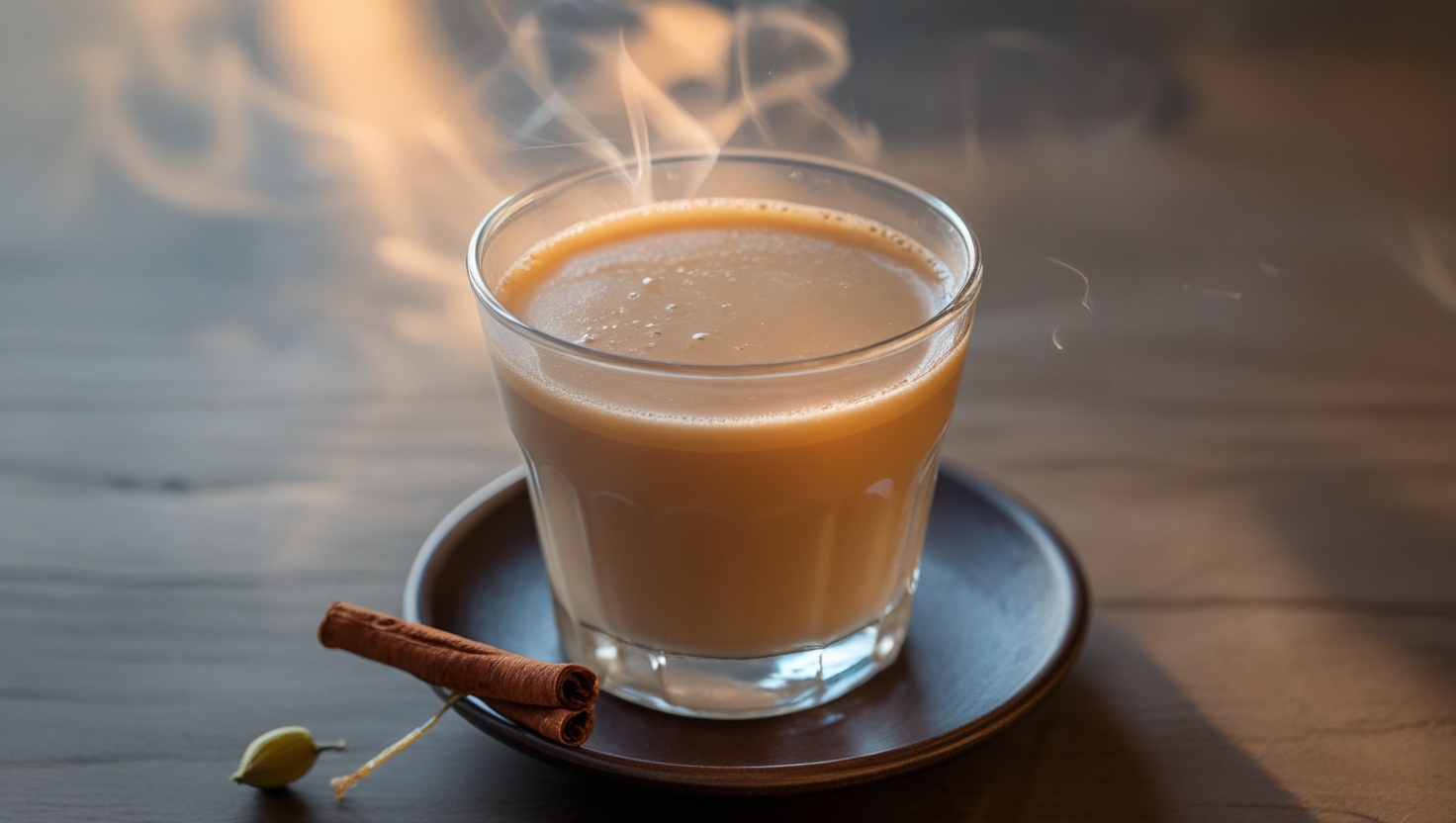

Masala Chai Recipe
A spiced, sweet milk tea simmered with whole cardamom, cinnamon, cloves, ginger and peppercorns until deeply fragrant, then strained hot.
Prep
Cook
Serve
Kcal
- 2 tbsp loose-leaf Assam or Darjeeling tea (or 3 English breakfast teabags)
- 12 slices fresh root ginger
- 1½ tsp black peppercorns
- 12 green cardamom pods, lightly crushed
- 2 cinnamon sticks
- 5 whole cloves
- 1 litre boiling water
- 50g granulated white sugar
- 500ml whole milk
Step 1
Thinly slice the fresh root ginger into 12 rounds and give the cardamom pods a light bash with the back of a knife so they crack open, just enough to expose the seeds - you're not trying to pulverise them.Step 2
Tip the tea, ginger, black peppercorns, cardamom pods, cinnamon sticks and cloves into a saucepan, then pour over the boiling water and bring it back up to a rolling boil over high heat.Step 3
Turn the heat down to a gentle simmer and let it bubble away for about 10 minutes, until the mixture smells strongly of warm spice and the liquid has darkened to a deep amber - this is how you know the flavours have properly infused.Step 4
Stir in the sugar and whole milk, turn the heat back up and bring the whole pan to the boil again, watching closely as milk can catch and boil over surprisingly fast.Step 5
Keep it at a steady boil for 10 minutes, stirring every so often so it doesn't catch on the base; a thin skin will form on top but don't worry, this gets strained out at the end.Step 6
Take a small spoonful and taste it - if you'd like a stronger, more intense chai, let it boil for a few minutes longer until it tastes as robust as you like.Step 7
Pour the chai through a fine sieve into cups or heatproof glasses, pressing the solids gently to extract every last bit of flavour, then discard the spent spices and serve immediately while piping hot.
Can I make this ahead and reheat it later?
Yes, strain it while hot, cool quickly and keep in the fridge for up to two days. Reheat gently in a saucepan over low heat until piping hot, stirring so it doesn't catch.
What can I use instead of whole milk?
A plant-based milk such as oat or almond works, but reduce the second boiling time since it won't develop the same skin, and it can split if boiled too hard.
My chai tastes weak, what went wrong?
It likely needed longer on the simmer before the milk went in, or a longer boil afterwards. Taste before straining and let it bubble a few extra minutes if it's too mild.
Do I need any special equipment?
Just a decent saucepan and a fine sieve for straining out the spices and tea leaves at the end. A tea strainer works if your sieve holes are too wide.
Can I use ground spices instead of whole ones?
Whole spices are worth sticking with here as they infuse gradually without turning the chai gritty or bitter. Ground spices tend to cloud the liquid and are much harder to strain out cleanly.
Is this chai very strong in caffeine?
It's brewed with a generous amount of loose tea simmered for several minutes, so it is noticeably stronger than a standard cup of tea. Use fewer tea leaves if you'd prefer it milder.
What it actually is
This is the sweet, milky, heavily spiced tea served in small glasses across Bombay's street-corner tapri stalls, built by boiling whole spices and strong black tea together before adding milk and sugar and boiling again. It is nothing like a teabag dunked in warm milk - the spices are properly cooked out, which is what gives it that deep, almost brothy intensity.
The ratio
The balance here matters more than it looks: a full litre of water carries the tea and spices, while a comparatively modest 500ml of milk and 50g of sugar are added afterwards to sweeten and enrich rather than dilute. Too much milk too early mutes the spice; too little sugar leaves the pepper and clove tasting sharp rather than rounded.
Scaling and batching
This recipe scales up neatly for a crowd - just keep the ratio of roughly 250ml water, 125ml milk, one whole spice set per two people and a spoonful of sugar per cup. Make a big batch in the morning, strain it while hot, and reheat gently in a saucepan rather than the microwave so it doesn't split.
Substitutions
Assam or Darjeeling loose tea gives the most authentic malty backbone, but strong English breakfast teabags work perfectly well if that's what's in the cupboard. Whole milk gives the chai its characteristic richness and helps it foam slightly as it boils; a plant-based milk works too, though it won't need boiling for as long since it doesn't form the same protein skin.